

Retatrutide is one of the most searched research peptides in the metabolic field, and it is the one that most rewards a careful, laboratory-first description. This article covers what retatrutide is as a research material: its chemistry, its triple-receptor mechanism, its analytical requirements and its regulatory status. It is written for researchers evaluating the compound. Nothing here describes any use in or on the body, no dose or protocol is given or implied, and retatrutide is not an approved medicine anywhere.
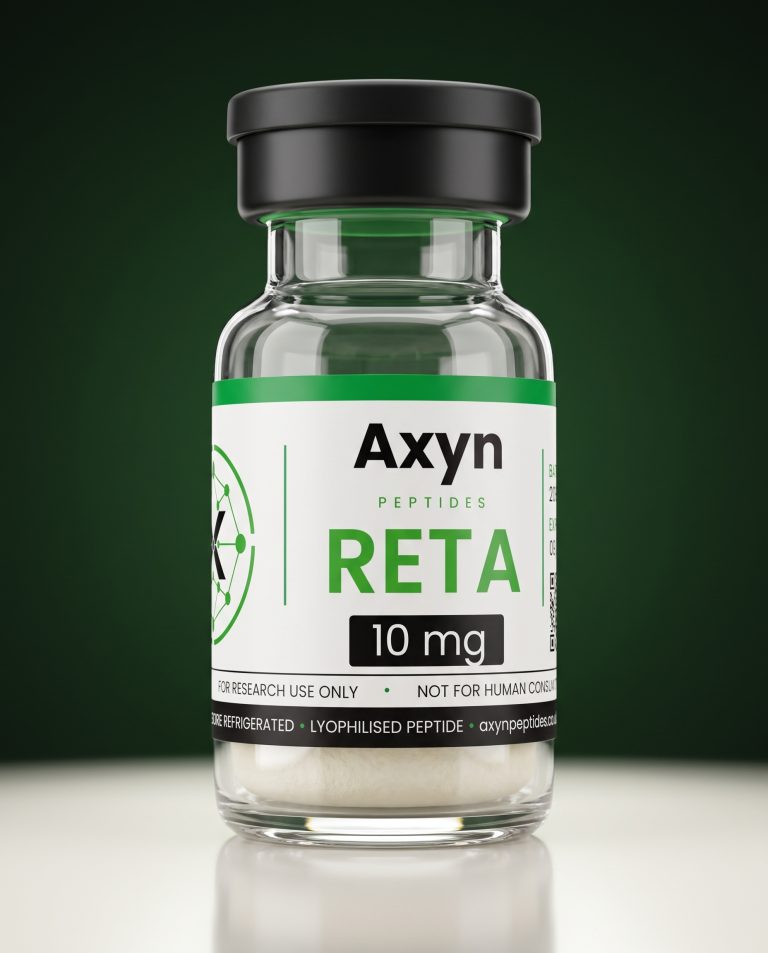
Retatrutide at a glance
| Aliases | Retatrutide; Eli Lilly LY3437943; “triple G” |
| Class | Single-molecule triple agonist of the GIP, GLP-1 and glucagon receptors |
| Sequence | 39-amino-acid synthetic peptide on a GIP-based backbone |
| Molecular formula | C221H342N46O68 |
| Molecular weight | about 4731 g/mol (free base) |
| CAS / PubChem | CAS 2381089-83-2; PubChem CID 171934787 |
| Typical salt form | Acetate (lyophilised); confirm on the certificate of analysis |
| Regulatory status | Investigational; not approved by FDA, EMA or MHRA. Research use only. |
Chemistry and structure
Retatrutide is a synthetic 39-residue peptide engineered from a GIP peptide backbone and tuned so that a single molecule activates three receptors at once. Three design features define it. First, non-coded amino acids give it protease resistance: 2-aminoisobutyric acid (Aib) sits at positions 2 and 20, with an alpha-methyl-leucine at position 13 and a C-terminal serinamide. These block dipeptidyl peptidase-4 (DPP-4) cleavage and slow enzymatic degradation, the standard strategy across this class.
Second, a fatty-acid acylation gives it a long-acting profile. A C20 fatty diacid is attached at Lys17 through a hydrophilic linker, and that fatty tail binds reversibly to serum albumin, shielding the peptide from renal filtration and enzymatic breakdown. Third, the potency is deliberately balanced: it is reported as more potent at the human GIP receptor than at the glucagon and GLP-1 receptors. The verified molecular formula is C221H342N46O68, with a free-base mass of about 4731 g/mol.
The triple-agonist mechanism
What makes retatrutide notable in the literature is that one sequence engages three receptors that are usually studied separately. GIP and GLP-1 are incretin receptors, while the glucagon receptor sits on the opposite side of glucose handling. Research interest centres on receptor pharmacology: how a single lipidated peptide can act as a balanced agonist across all three, and what the tuned potency ratio means for selectivity and stability. This is a description of receptor science, not of any outcome in a living system.
Research status
Retatrutide is investigational. It has been studied in a Phase 2 programme and is the subject of a large Phase 3 programme, the TRIUMPH, TRANSCEND and SYNERGY trial families, spanning metabolic and liver-related research with more than 5,800 participants. For anyone sourcing it, the key fact is that it has no marketing authorisation from the FDA, EMA or MHRA, and long-term safety data and full Phase 3 publication are still in progress. In the research market it is supplied only as a lyophilised vial, never in the multi-dose pen format used for approved medicines.
Handling and quality control
Retatrutide is supplied lyophilised in a sealed vial and reconstituted to a solution of known concentration for bench work; our reconstitution guide and calculator covers the maths. Store the dry powder cold and protected from light, and treat any reconstituted material as a short-lived, cold-chain-dependent stock. As a large acylated peptide it is sensitive to repeated freeze-thaw, heat and light. See our storage and shelf life guide for the detail.
Because it is a long, heavily modified peptide, quality control matters more here than almost anywhere in the range. A certificate of analysis that says only “retatrutide” is not enough: it should state the salt form and give an expected versus observed mass by mass spectrometry, not purity alone. There is no official pharmacopoeial reference standard for retatrutide, so identity rests entirely on the manufacturer’s analytical package, and synthesis-related impurities such as deletion sequences and incomplete acylation are real analytical concerns. Our guide on reading a certificate of analysis explains what a strong certificate looks like, and every batch we supply is third-party tested with its own certificate.
Regulatory and research-use position
Retatrutide sits in the GLP-1 incretin class, which attracts the heaviest regulatory scrutiny of any peptide category. It is supplied strictly for laboratory research use only, with no indication, no dosing and no human-use framing. That discipline is not just house style: under UK and EU medicines law a product can be treated as a medicine from how it is presented, so research-use language is what keeps a research material a research material.
Frequently asked questions
What is retatrutide?
Retatrutide is a synthetic 39-amino-acid peptide described as a triple agonist of the GIP, GLP-1 and glucagon receptors, supplied as a lyophilised powder for laboratory research use only.
Is retatrutide approved?
No. Retatrutide is investigational and has no marketing authorisation from the FDA, EMA or MHRA. It is a research material only.
What is a triple agonist?
It means one molecule that activates three receptors, in this case GIP, GLP-1 and glucagon, rather than a single receptor. It is a description of receptor pharmacology.
How should retatrutide be stored?
Keep the lyophilised powder cold and out of light. Once reconstituted it is far less stable, so it is refrigerated, protected from light and treated as a short-lived stock.
References
- PubChem, Retatrutide, CID 171934787 (chemistry and identity): pubchem.ncbi.nlm.nih.gov
- Jastreboff AM et al., Triple-Hormone-Receptor Agonist Retatrutide, New England Journal of Medicine 2023;389:514-526: nejm.org
- FDA, concerns with unapproved GLP-1 drugs: fda.gov
View the tested material on the retatrutide product page, or browse the wider Metabolic and GLP-1 category.
For research use only. Not for human consumption. Not a medicine, supplement or cosmetic. No therapeutic use is stated or implied.
Leave a Reply