

CJC-1295 is sold in two research forms, “with DAC” and “without DAC”, and the difference is not cosmetic: it changes the molecule, its mass and its stability profile. This article explains what separates them as laboratory materials, why the naming is a genuine identity trap, and what a certificate of analysis has to show to tell them apart. Nothing here describes any use in or on the body, and no dose or protocol is given or implied. Neither form is an approved medicine.
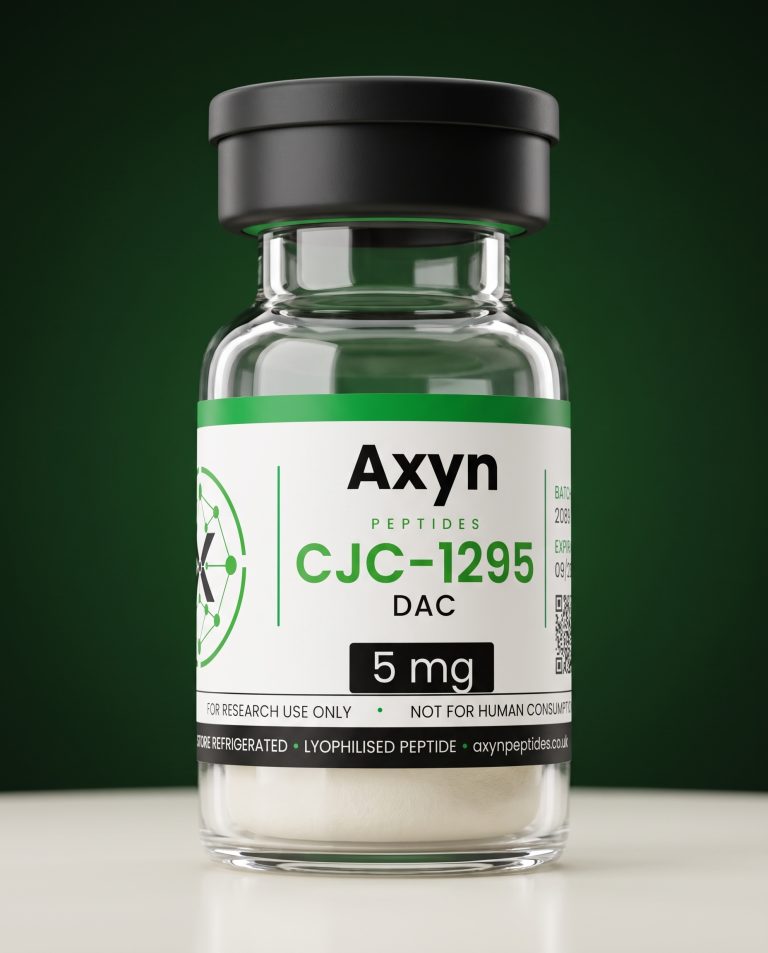
CJC-1295 with and without DAC at a glance
| Property | Without DAC | With DAC |
|---|---|---|
| Also called | Modified GRF(1-29) | DAC:GRF; the original CJC-1295 |
| Backbone | GRF(1-29), 4 substitutions | Same, plus Lys30 and an MPA linker |
| Molecular formula | C152H252N44O42 | C165H269N47O46 |
| Molecular weight | about 3367.9 g/mol | about 3647.2 g/mol |
| PubChem CID | 56841945 | 91971820 |
| Albumin binding | None | Covalent, via the DAC linker |
| Reported half-life | about 30 minutes | about 6 to 8 days |
The shared backbone: modified GRF(1-29)
Both forms start from the same 29-residue analogue of human GHRH(1-29), the hormone also known in its native medicinal form as sermorelin. Four substitutions are engineered in to slow enzymatic breakdown. The most important is position 2, where L-alanine becomes D-alanine, blocking cleavage by dipeptidyl peptidase-4 (DPP-4), the enzyme that clips native GHRH at the N-terminus. Position 8 (Asn to Gln) removes a deamidation-prone residue, position 15 (Gly to Ala) adds helical stability, and position 27 (Met to Leu) removes an oxidation-sensitive methionine. As a class the molecule is a GHRH-receptor agonist studied for how it amplifies the natural pulsatile release of growth hormone rather than supplying growth hormone directly.
What the DAC adds
DAC stands for Drug Affinity Complex. The “with DAC” form adds a lysine at position 30 and a maleimidopropionyl (MPA) linker to that backbone. The chemistry is the whole point: after administration the maleimide group reacts with the single free thiol on cysteine-34 of circulating serum albumin, forming a stable covalent bond in situ. The peptide is then tethered to albumin, a carrier protein with a circulating half-life of roughly 19 days, which shields it from renal filtration and from proteases. That is why the reported plasma half-life jumps from minutes for the no-DAC molecule to about 6 to 8 days for the DAC form. A Phase I human study (Teichman et al., Journal of Clinical Endocrinology and Metabolism, 2006) established this extended profile, with an estimated half-life of 5.8 to 8.1 days after a single subcutaneous dose. It is one of the few peptides in this market with genuine published human pharmacokinetic data, and that data is on the DAC form specifically.
Why the difference matters for identity and QC
Here is the trap. The original CJC-1295 developed by ConjuChem was the DAC, albumin-binding molecule. The research market later applied “CJC-1295 without DAC” to plain modified GRF(1-29), so the same catalogue name now points at two different molecules with two different masses: about 3367.9 g/mol without DAC and about 3647.2 g/mol with DAC. The roughly 279 Da gap is the added lysine plus the MPA linker. On mass spectrometry the DAC form is the heavier peak, so if a certificate that claims “with DAC” reports a mass near 3368, you have been shipped the short-acting molecule. Because the CAS number 863288-34-0 is applied inconsistently across the whole CJC-1295 series, identity should be resolved by observed mass, not by trade name or CAS.
There is a stability angle specific to the DAC form as well. The reactive maleimide on the linker can hydrolyse over time and react with any stray thiol, so aged, poorly stored or repeatedly freeze-thawed material can lose its ability to conjugate to albumin, quietly degrading the very feature that defines the molecule. A simple purity percentage will not necessarily reveal this, which is another reason a certificate should confirm the intact species by mass spectrometry.
Handling and storage
Both forms are supplied lyophilised and reconstituted to a solution of known concentration for bench work; see our reconstitution guide and calculator. Store the dry powder cold and protected from light, and treat any reconstituted material as a cold-chain-dependent stock; see the storage and shelf life guide. The four backbone substitutions make the dry peptide comparatively robust, but the DAC form carries the added maleimide-stability consideration above. Whichever form you are evaluating, our guide on reading a certificate of analysis explains what a strong certificate looks like, and every batch we supply is third-party tested with its own certificate.
Frequently asked questions
What is the difference between CJC-1295 with and without DAC?
The “with DAC” form adds a lysine and a maleimidopropionyl linker that bonds covalently to serum albumin, extending the reported half-life from about 30 minutes to about 6 to 8 days. Without DAC, the molecule is plain modified GRF(1-29).
What does DAC stand for?
Drug Affinity Complex. It is the albumin-binding linker that distinguishes the long-acting form from the short-acting one.
How can a certificate of analysis tell the two apart?
By observed mass. The no-DAC molecule is about 3367.9 g/mol and the DAC form about 3647.2 g/mol, a difference of roughly 279 Da. A “with DAC” certificate reporting the lower mass indicates the wrong molecule.
How is CJC-1295 stored?
Keep the lyophilised powder cold and out of light. Once reconstituted it is far less stable and is treated as a short-lived, cold-chain-dependent stock.
References
- Teichman SL et al., prolonged stimulation of GH and IGF-1 by CJC-1295, a long-acting GHRH analogue, JCEM 2006 (PubMed 16352683): pubmed.ncbi.nlm.nih.gov
- PubChem: CJC-1295 with DAC (CID 91971820) and without DAC (CID 56841945): pubchem.ncbi.nlm.nih.gov
View the tested material on the CJC-1295 DAC and CJC-1295 without DAC product pages, or browse the wider Growth Hormone Secretagogues category.
For research use only. Not for human consumption. Not a medicine, supplement or cosmetic. No therapeutic use is stated or implied.
Leave a Reply